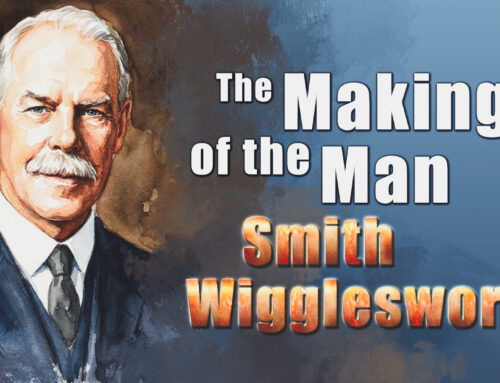
Smith Wigglesworth Part 2- From Trial to Triumphant
1907-1929
Smith said- “How glad I am that God baptized me in the Holy Ghost. What a wonderful difference it has made in my life.”
Indeed, after receiving the Baptism of the Holy Spirit, Smith Wigglesworth was a radically different person. God would launch this uneducated nobody into one of the most powerful global ministries. This man, who ran from the pulpit, was now preaching worldwide.
Hi, my name is Robert Pears. I love to study the heroes of the faith and tell their stories so that we can learn what they did right and what they did wrong, and so that we might be catapulted into our divine purpose. I also love to study the revivals of the past so that we might be provoked to pray for a fresh move of God in this generation.
In this, part two of the Smith Wigglesworth story, we will look at his life and ministry from the time he was baptized in the Holy Spirit to around 1929, which will include his ministry going beyond his Jerusalem of Britain, to the nations.
Baptism in the Holy Spirit
Despite all her efforts, Polly only got Smith to say a few words and never really preached. But God had a solution, and it would come in 1907.
In 1906, the Azusa Revival in Los Angeles birthed modern Pentecostalism, and in 1907, Alexander Boddy brought it to Britain. Boddy was the pastor of an Anglican church in Sunderland.
Pastor Boddy was keen to see revival. He had gone to the Welsh Revival and then went to Norway, where Pastor Barratt, who had returned from Azusa, saw Pentecostalism break out in his church.
Seeking the outpouring of the Holy Spirit in Britain, Pastor Boddy held a waiting service at Sunderland, during which the presence of God fell mightily.
Well, word of this revival spread.
Around this time, a man came to their home asking Smith to pray over his leg. He had cancer, and his leg was like a board. Smith told the man to fast for seven days and seven nights, and then his leg would be like a child’s. 46 The man followed Smith’s instructions, and after four days, Smith saw the man stop by again. He was not pulling himself up by the railings but walking.
“I am perfectly healed… I am going back to fast a further three days and nights but I thought I would let you know what God had already wrought.”47
The man asked Smith if he had heard about what was happening in Sunderland with Vicar Boddy.
Boddy and Smith already had a history together. Back in October 1906, Smith came to the church and prayed for the healing of a sick lady. This would later be reported in Boddy’s Sunderland newsletter, the Confidence. Boddy, like Smith, had believed in divine healing before becoming Pentecostal.
Smith was curious about the Pentecostal revival happening at Sunderland and so wrote to two people who had come to know the Lord at Bradford regarding Sunderland.
Well, the people wrote back, stating that what was happening was a dangerous error. They didn’t believe that speaking in tongues was for today. Smith, however, decided to pray about it and finally went there to find out for himself. Initially, Smith was disappointed because he wanted to experience tongues but didn’t. So, Smith decided to visit a nearby Salvation Army church and explained how he came looking for tongues and was told that it was the devil and to stay away from the Pentecostals.
After spending four days in Sunderland, Smith decided it was time to return home. But before he left, he went to the pastor’s home and met Mrs. Boddy. She prayed for Smith to receive the baptism of the Holy Spirit. For the first time, Smith truly felt cleansed and filled with joy. The fire fell on Smith, and he was changed. He said…
“I was given a vision in which I saw the Lord Jesus Christ. I beheld the empty cross, and I saw Him exalted at the right hand of God the Father. I could no longer speak in English but began to praise Him in other tongues as the Spirit of God gave me utterance. I knew then, although I might have received anointing previously, that now, at last, I had received the real baptism in the Holy Spirit as they received on the day of Pentecost.”48
Smith would write and share his testimony with Boddy, who published it in his Confidence newsletter. In the testimony, he explained:
“After 7 full days of the Glorious Presence of the Glory of God resting upon me, I send you this testimony for the Glory of God…Today I am actually living in the Acts of the Apostles’ time, I am speaking with new tongues, the Holy Fire of God’s Presence fills me till my pen moves to the glory of God, and my whole being is filled with the Presence of the Holy Ghost… (Confidence, October 1908, P11, 15-16).
When Smith got home, his son George asked him if we had got the gift of speaking in tongues. Polly having heard as well that he was speaking in tongues said to him…
“I want to you to understand that I am as much baptized as you are and I don’t speak in tongues”49
She then explained that he would preach on Sunday, and she was going to see for herself what change had happened. So, on Sunday, Smith climbed the three steps to the platform and, to everyone’s surprise, began to preach from Isaiah 61:1-4. Smith heard the Lord speaking through him, and so did his wife, Polly, who became astonished and started crying, ‘That’s not my Smith, Lord, that’s not my Smith.”50
As they wrapped up the service, the mission secretary stood up, saying he wanted what Smith had. He tried to sit down but missed his seat. Soon, eleven people were on the floor, laughing with joy 51
This was to be the beginning of the outpouring at the Mission. Everyone began speaking in tongues and worshipping. We know that Smith placed heavy importance on true worship. He felt that we try to worship too often, and that our worship is often just mechanical. He believed true worship comes from our spirit, man. Worship should be an outflowing from the very depths of our being.52
Smith further stated, ‘When I catch the first breath of the Spirit, I leave everything and everybody to be in His presence, to hear what He has to say to me.”53
We must get rid of the noise of life and develop a sensitivity to the Holy Spirit so we, like Smith, can sense His presence and go hear what He has to say to us.
The Confidence would publish a report on the Bowland Street Mission in April 1908 (p 6-7), stating:
“Bowland Street Mission, Bradford, has had many days of God’s right-hand, and has won many trophies of the Cross … Those that were lifeless and helpless (having to be carried), are now full of life and prepared to carry others from the cold, indifferent, formal life to be red-hot, spirit-filled saints, speaking and singing in Tongues.”
Greater Impact
Shortly afterward, Smith was called to a factory that employed more than a thousand people in Lancashire. They wanted to know about the baptism. Smith went and shared the Baptism, and many were saved and baptized. Shortly after this event, he was invited to a town in Shropshire. Here, he preached at a Methodist church, and the fire fell. However, the city did not receive speaking in tongues and began to persecute Smith. But Smith continued pressing forward, and one day, he was at a grocery store when three women came under intense conviction and were saved. 54
Everywhere Smith went, people started coming under great conviction.
In 1908, Smith would join a young George Jeffreys and their paths merged, creating a formidable and unbreakable relationship when they were both asked to preach at Rev. Boddy’s First Annual Sunderland Whitsuntide f
While Smith and Polly traveled and preached during this time, they remained committed to the Bowland Street Mission. In fact, Smith bought the largest flagpole he could and placed it outside the Mission. It put up a flag that said, “I am the Lord that healeth thee.” 57 This was a time when the Lord was teaching Smith and increasing his impact:
“God moved me on to a place of increasing faith, causing me to see the Word of God was written to show us how to act on the principles of faith.”58
On page two of the 1908 July issue of the Confidence newsletter, Boddy listed the various Pentecostal centers in Britain, which included Smith Wigglesworth’s Bradford Mission. Very quickly, Smith was gaining recognition as a leader among the early British Pentecostals, thanks to his close relationship with Boddy.
In 1909, Smith held his first annual Easter convention, which was also reported in the Confidence, providing great publicity for him and the event.
At Boddy’s 1909 Annual Sunderland Conference, one of the guest speakers was Carrie Judd Montgomery. Smith, who was also a speaker connected with the Montgomerys. Consequently, Carrie and her husband would become powerful friends with Smith and Polly.
Carrie experienced healing when she was younger under the ministry of Mrs. Mix and was then launched into ministry with Mrs. Mix as part of the holiness and divine healing movement. Later, she joined the Salvation Army. The deep friendship between the Montgomerys and the Wigglesworths may, in part, have stemmed from both groups’ membership in the Salvation Army and their strong belief in divine healing. Later, when Smith visited America, he went to the Montgomery’s’ mission, and, in fact, he would preach there often.
Cecil Polhill, the leader of the Pentecostal Missionary Union (PMU) and a wealthy, influential Pentecostal, began holding a series of meetings at various locations. Smith and Polly were among the preachers at his meetings and even taught at the Sion College of Theology in May of 1909. Many at the college received the baptism in the Holy Spirit.c
The Confidence reported on this in the April 1909 edition.
“Mr. and Mrs. Smith Wigglesworth’s visit was greatly blessed, their strong faith being an encouragement and stimulus and help to all.”
Smith was not being invited to preach at various conferences throughout Britain and even in France.
Smith then went to a town near Grantham, where a young man was critically ill. Smith arrived at Grantham and then had to ride a bike nine more miles to make it to the house. When he arrived, it was too late, as the boy was about to die. However, Smith explained that God is never late, and realizing the boy was beyond human help, he went to pray. He prayed most of the night and rose early to pray in the fields. He then returned to the boy’s house and asked them to air out his clothes because the Lord would raise him up, and he would wear them.
Smith preached at the local church on Sunday morning and asked all to stand with him in faith for the boy. Afterward, Smith returned to pray for the boy. He told the parents to put the boy’s socks on. Then he asked them to leave the room and shut the door. Snith understood the need to abide in the Secret Place-
“I think it is a very important thing to have the door shut, when you have a case like this to deal with, for then you know you are able to just shut in with God.”55
Smith prayed, the power fell, and the boy arose and got dressed. The whole town heard about what happened, and a revival broke out that day.
Around the same time as Smith was having great success, traveling problems were brewing at the Mission. In the February 1910 issue of the Confidence (p. 35), someone visited the Bowland Street Mission from Canada and wrote:
“…They are not in sympathy as a body with Pentecost, and personally one feels they may be a source of weakness in meetings…”
As we will see later, those in leadership who disagreed with the Baptism of the Holy Spirit would become a problem. We must remember that Smith and Polly were just earthen vessels and had to learn many things. Please note that Smith vehemently opposed strife.
Full-Time Ministry
Smith was becoming increasingly busy, and the cold weather meant plumbers were in high demand. But Smith could not get to them and started losing his customers. Smith decided he would do his last plumbing job for an old lady, free of charge as an offering to the Lord.
A friend had made a comment to him: “All the people who say they live by faith seem to have their heels worn out, and their clothes are old and green.”56 So Smith told the Lord he would obey, but that if ever his heels became worn down or his clothes had holes, he would return to plumbing.
Smith never did return to plumbing, and the Lord never allowed Smith to have his heels worn down or holes in his clothes. But as Smith would preach, the truths that you stand for, well, you are tested on, and a test would soon come.
As Smith closed his plumbing business, many people owed him money for work he had done as a plumber, and it appeared that it would take a court action to get the money he was owed. But Smith decided to trust the Lord, and soon, a young man came with a gift of fifty pounds, which was enough to cover his debts.
Smith was now receiving many preaching invites throughout Britain and Northern Ireland.
Polly Goes Home
1912 was a very busy year for the Wigglesworths, with both preaching. Then on January 1st, 1913, while on a preaching trip in Kilsyth, in Scotland, just northeast of Glasgow, Polly suffered a heart attack and died. Smith was over 250 miles away when it happened. Polly once told Smith, ‘Smith, you watch me when I’m preaching. I get so near to Heaven when I preach that someday I’ll be off.” D Smith, as was the norm, instructed that his wife be placed on the bed until he got home. When he got home, he went up to the bedroom and shut the door. Smith then rebuked death, and Polly opened her eyes and said:
“Why have you done this, Smith?’
‘Polly, I need you,’ he said
‘Smith my work is finished,’ she answered, ‘God want me.’
They talked for quite some time, then Wigglesworth said, ‘All right, I will let you go.”60
Later, while in New Zealand in 1922, he was asked what the secret of his power was, and he answered:
“In a broken voice, and with tears slowly trickling down his face, he replied:
I am sorry you asked me that questions, but I will answer it. I am a broken-man. My wife, who meant everything to me, died eleven years ago. After the funeral, I went back and lay on her grave. I wanted to die there. But God spoke to me and told me to rise up and come away. I told him if he would give me a double portion of the Spirit- my wife’s and my own- I would go and preach the Gospel. God was gracious to me and answered my request. But I sail the high seas alone. I am a lonely man, and many a time all I can do is to weep and weep.”61
Smith would also say, “out of our emptiness, brokenness and yieldedness of our lives, God can bring forth all His glories through us to others.”62
We all want the power, and many want to be just like Smith, but few are willing to pay the price. Listen to these words of Smith:
“It is through the power of the Holy Ghost. You must not think these gifts will fall upon you like ripe cherries. There is a sense in which you have to pay the price for everything you get. We must be covetous for God’s best gifts, and say A, men to any preparation the Lord takes us through, in order that we may be humble, usable vessels through which He Himself can operate by means of the Spirit’s power.”63
New Doors Opened
In September 1913, Polhill opened a Men’s Training Home in London (it was not part of the PMU, which he was leader of). It was located at 60 King Edward Road in Hackney. Among those trained were George Jeffreys and Frederick Johnstone. Here, Smith would oversee the Bible School for a season.f
Also in 1913, Smith was invited to preach in Belfast with George Jeffreys and then in Wales. George Jeffreys attended the PMU Bible School simultaneously with James Salter who would become Smith’s son-in-law. George Jeffreys and Smith would become very good friends.
Later, Smith would actually write several letters to George Jeffreys.
The Feast
Smith believed in doing the Word. So, when he read something in the Word, he sought to find a way to do it, and this included holding a feast and inviting the poor, maimed, the lame, etc., from the byways. Smith felt compelled to invite all the needy to a banquet at the Mission.
The feast was a success; many came, and he provided them with a first-class meal, including roast beef and Yorkshire puddings. After the meal, he had people who had been healed to share their testimonies. This went on for around an hour and a half, provoking others to believe in healing. The result was that many were healed and saved. 59
As the Lord opened many doors for Smith during this season, he also experienced many trials. It was a season in which God made Smith, and many of his messages that bless us today came from this time, as Smith had to walk it out by faith. During the difficult times, instead of becoming bitter or discouraged, Smith discovered how to overcome and move forward.
Smith would preach:
“The elect of God are those that keep pressing forward. The elect of God cannot hold still. They are always on the move. Every person who has a knowledge of the elect of God realizes it is important that he continues to press forward. He cannot endure sin nor darkness, nor things done in the shadows. The elect is so in earnest to be right for God that he burns every bridge behind him.”
The devil loves to get us offended at the Lord. In this season, it would have been easy for Smith to have been offended, and such offense would have opened the door to bitterness and could have shut down his ministry. Smith’s ministry was beginning, and the devil sought to shut him down, but Smith discovered that giving the offenses to the Lord and trusting Him enabled him to get the breakthrough. He also found a powerful key: the deaths that we die produce life for others.
Smith shared in his message, “Faith’s Testing,” he said, “I am to die if I am to cause other people to live.”
He would also say:
“Great faith is the product of great fights. Great testimonies are the outcome of great tests. Great triumphs only come out of great trials.”64
International Ministry
In April 1913, Smith preached at a conference in London, which was reported in the newsletter “Flames of Fire, May 1913. At the conference, there was a list of international preachers, which included Frank Bartleman from the Azusa Street Revival.
It was in 1913 that Smith felt led to go preach in America and Canada. Little did he know that God was already putting the wheels in motion for this to happen.
While he was speaking at the Sunderland conference, Smith held a baptism service in the cold waters of the North Sea along the coast of Sunderland that would be featured in the Daily Mail. This event could have offended his friend Boddy, but Smith and Boddy had developed a strong partnership that endured throughout.
As Smith pressed forward, God honored Smith’s obedience and opened a new door. Never could this man, whose humble beginnings included picking turnips in the English Countryside, have imagined the destiny God had for him.
Amid all that Smith endured during this season, he came to understand that God was making him. Smith would say:
“The man who is going through it with God to be used in healing must be a man of longsuffering.”65
Smith went through a lot, and through it all, as he trusted the Lord, his heart was tenderized.
Smith would soon begin traveling the world, and when he went, he was ready for the challenges presented to him, and he always preached salvation and healing. While in Sweden, Smith was arrested for preaching healing, as they believed he was simply trying to make money. However, there was no law against preaching, so he was released. However, he was not allowed to lay hands on people.
Smith preached to crowds of twenty-plus thousand.66 Smith, to avoid breaking the law, especially as government officials were watching, told all sick to take care of themselves. Smith would say, “If there is a God, there’s a way.”68
Next Stop America
The world for Smith was rapidly growing, and he soon would find himself in America, and even though he was unknown, he rapidly gained a powerful reputation.
The tragedies and trials had served to work on Smith and make him more compassionate for the lost and those who are sick. After the death of Polly, Smith’s daughter Alice became a critical part of his ministry. Alice (1884-1964), while in her twenties, became a missionary in Congo and married Mr. Smith in 1911, but he died of a disease. She would then marry James Salter (1890-1972), and he would be one of the pioneers of the Congo Evangelistic Mission. Alice and James would begin traveling with Smith on his international trips.
The Redemptive Tidings would later write:
“He was intimate with God before 1914, but in that year God sent him to America for the first time, as he used to say, ‘to teach him geography.’ Having recently lost his wife, one who had done much to make him thus far, he went abroad in an abandonment to God that found a continent-wide fruition in all the United States and Mexico. From that time his gifts made room for him, and continents and countries opened wide to the ‘Plumber-Preacher.’ New Zealand was swept, Columbo in Cylon shaken, Sweden roused, Switzerland stormed, Norway inflamed and California stirred to its depth as God confirmed His Word through this “Mantled man.’ The permanence of these works is visible to this day in that souls were saved, bodies were healed, lives changed and delivered and Assemblies of believers were established.”i
Before going to America, Smith told the Lord, “You have three things to do: you have to find money for home and find money to go, and you have to give me a real change, for you know that sometimes my mind or memory is no good at all.”e
In April 1914, Smith finally went to America. The Confidence would announce Smith’s plan and be a powerful tool for him to share testimonies of his campaigns. The friendship and support of A. A. Boddy were a powerful blessing, and his partnership was invaluable.
Smith traveled throughout the US and Canada. He even came to Chicago and Zion, Illinois, the city founded by Dowie.
The fact is, many of the churches Smith visited were started by people who were from Dowie’s Zion City, Illinois, and his church. As we discussed in the first part, Polly Wigglesworth was connected to Dowie and, in fact, was baptized by him in 1901 when he came to Britain. The Wigglesworths had actually received Dowie’s newsletter, the Leaves of Healing.
.
At the Stone Church in Chicago, Smith was asked to pray for a man called Matthew, who was dying. Smith spent the night in prayer. For six weeks, the man continued to get worse, at which point Smith asked for his clothes to be aired out. Then Smith went into the man’s room and laid a hand on him. Smith prayed over the man for fifteen minutes before the man recovered. His father was a backslider and, upon seeing what happened, cried out for mercy. His sister then also got delivered.
In the summer of 1914, Smith reconnected with the Montgomerys and preached at the World-Wide Pentecostal Camp Meeting under the Redwoods. After this, he made his way to Los Angeles, where he would connect with the infamous Aimee Semple McPherson. They hit if off and Smith would return often to preach and teach for her.
Smith sent a message to Boddy, stating:
“At all points, at all places, including Oakland and Los Angeles, the buildings were thickly packed with people eager to hear the Word of God, and one feels now, as never before, that as the spirit rests upon us, they press to hear the Word of God, as is mentioned in Luke v. 1, God help me!” (Confidence, December 1914, p 228-229)
Finally, in March 1915, Smith returned home in time for his annual Easter Convention at the Bowland Street Mission.
A photo of Smith, who was now in his fifties, was featured on the front page of Confidence in the December 1915 issue.
Unfortunately, the First War had broken out, and it restricted international travel, and at the same time, many conventions were put on hold.
Smith held his annual Easter Convention at the Mission in 1916. Brother Booth Clibborn was one of the speakers at the conference, which focused on revival. Smith and George Jeffreys were among the speakers.
Smith continued to preach throughout Britain and Ireland during the war.
It wasn’t until 1920 that Smith began traveling internationally again. In late April, Smith went to Switzerland, and during this trip, his campaign in Bern was held in a casino.
A letter was written about the mission and Smith. Regarding Smith, they said: “Bro. Smith Wiglesworth brought us the Word of God, which the Holy Ghost especially emphasized by these powerful utterances in tongues and interpretation. Bro. Smith Wiglesworth is very humble, and the naïve way in which he told us that he could not read before he was 23 years old, and that his wife taught him, moved many, and led us to magnify the Lord, who chose fishermen and other working people to be His representatives when He left the earth. When he is in the natural, which is not often, one sees the humble origin, the imperfect education, the man of the people; but when in the Spirit one is conscious of the presence of Someone else who is altogether lovely. Bor. Smith Wigglesworth’s great strength is his humility and his love for Jesus and longing that He alone should have all the glory.”(Confidence, April/June 1920, 19-21).
Smith then went to Zurich, Basel, and several other cities. While Smith was in Switzerland, so was a young American evangelist called Lester Sumrall. (Redemption Tidings, Feb 24, 1939, p 3). Lester would eventually meet Smith in 1936, and they developed a powerful friendship. Sumrall, however, wrote of Smith in Switzerland:
Great crowds gathered to hear the unique messenger and see the wonders of God made manifest in our generation. The fruit of our brother’s ministry is seen in the nine Assemblies still remaining, brought into being by his visits. Also, there are men and women in the respective Assemblies who received and have retained healing under his anointed ministry…Inspiration and faith increased in the hearts of those who heard him, and resulted in a general benediction upon the entire Movement.”
Trial and Controversy
Two years after losing Polly, on March 22nd, 1915, his son George died, most likely from the battlefields of Flanders during World War 1.
Also in 1915, Smith joined the Pentecostal Missionary Union. Around 1920, he told a lady that they “had a spiritual affinity.”70 Mr. Broome, who had accompanied Smith on some of his recent trips, began teaching about a “spiritual affinity,” in which a man and woman have a very special relationship with each other and one where they are on a higher plane than mere love. The woman was offended, and she and a friend filed a complaint of inappropriate behavior.
The woman, along with a friend, filed a complaint to Cecil Polhill, who immediately consulted John Leech, the law officer of the PMU. Polhill, however, involved no one else in the leadership of the PMU, nor did he seek their input, and decided that the PMU had to take action against Smith. Polhill, acting as the voice of the PMU, demanded an apology, to which Smith gave one. However, Mr. Cecil Polhill, as the head of the PMU, didn’t believe that Smith had fully repented and believed that Smith should step out of ministry until they deemed he was fully restored.
Cecil, who was also a key financier of the early Pentecostals, had the power to hinder, or even end, Smith’s ministry.
Smith, however, was surprised by the lack of support from Polhill, with whom he had known and worked with many years. Smith was told to resign from the PMU and sign a letter of repentance. Well, Smith did resign but refused to sign any letter. Polhill had demanded:
That Smith “abstain for a prolonged season from participation in the Lord’s public work, and seek to retrieve your position before God and man, by a fairly long period of godly, quiet living, so showing works meet of repentance.”
The issue for Polhill was about Smith’s meeting with three Bradford Mission elders. The men at the Mission felt the women merely acted to ruin the ministry of Smith’s. Smith responded:
“I think that Mr. Polhill has stepped over the boundary this time making things to appear as if I had committed fornication or adultery and I am innocent of those things. I have done and acted foolishly and God has forgiven me. This thing is settled in the spiritual way and after this at the church and with Mr. Polhill and he ought to of have seen things through.”72
Smith was clearly offended by the nature and tone of Polhill’s letter and his failure to consider Smith’s well-established reputation. No investigation was taken, and Polhill acted as judge and jury, condemning Smith. A copy of Miss Amphlett’s complaint letter is unavailable, making it harder to find the full complaint, which is surprising given the PMU’s meticulous record-keeping of meeting minutes and notes. Further, no information is given about who these ladies were. It is possible that Miss Amphlett was the woman who sought to give money to George Jeffreys for the building they sought, but John Leech strongly opposed it on the grounds of her conditions. F
Smith did admit to being foolish, but had done nothing to merit such punishment. Smith went on to write in another letter:
“…God will settle all. The good hand of God is upon me and I will live it all down. This week, God has rebuked the oppressor through his servant. I shall go forward, dear brother, and ask you to be careful that the Gospel is not hindered through you and ought at this time to do unto me as you would wish one to do unto you. Do not trouble to send anything for me to sign. I signed my letter to you, that (is) all.”73
One of the key PMU leaders, Alan Boddy, was not present at the time and opposed Polhill’s actions. He was a close friend and supporter of Smith. Boddy would remain a close friend, ally, and supporter throughout his life. Mundell, another PMU leader, also felt things were taken out of proportion. He would continue to assist Smith and enabled him to obtain the 10% discount on the boat tickets for traveling as a minister.
Smith’s ministry did not go into decline or lose any of its power. Instead, his ministry grew, and the man and ministry that we know today is the consequence of him pressing forward. Smith refused to bend to religious politics and bravely decided to obey the Lord over a man, even to his own hurt.
In reading Smith’s letters and messages later in life, it is clear that this was a time when Smith was dying in the wilderness, and like Jacob, of whom he would later preach, became desperate for the Lord. He discovered that the death he was dying was producing life for others. Smith came out of the trial stronger and with a greater impact.
Pressing Forward
Smith pressed forward and in 1920, went to Switzerland and Sweden. In Switzerland, they declared they had an “open heaven.”76
While in Switzerland, a woman came forth with cancer on her nose. Smith had her come up front and had everyone look at her. He then said how she would return the next night to tell what the Lord had done for her. He then prayed over her. The lady did indeed return the next night, and her cancer was gone. Another lady with some terrible disease on her face had the same thing happen and returned with a face radiant and covered in new skin. 77
Smith believed not only in divine healing but also in walking in divine health. While in Switzerland, a dentist, Dr. Emil Lanz, came to the meeting to prove Smith was fake. He went up and asked Smith to open his mouth to show that Smith’s teeth were false. The dentist, however, was amazed to find that Smith had perfect teeth. Dr. Lanz was converted and trusted in the Lord. 78
New Doors and New Eyes
In 1921, while Smith was in Switzerland, he was asked to pray for a man with no eyes. One day, while Smith was walking with the pastor, they met someone who said, “There is a blind man at the mission and he says he is not going to leave there until he gets new eyes.”
Smith saw it as an opportunity and so went and laid hands on the empty sockets and prayed in the name of Christ. Immediately, God worked a miracle, and the man could see. The healed man was eager to see his parents and the streets he had walked for so many years, simply feeling his way through them.
Smith would remain with a full schedule in Switzerland until the 7th of February, when he had to leave for Sweden. While he was in Switzerland, hundreds gave their lives to Christ, just as the League of Nations (later the U.N.) also met nearby.
Smith preached at Pastor Barrett’s in Sweden with great success. Smith went to Norway and then Denmark. It was reported in the Pentecostal Evangel (May 27th, 1922, p 10):
“The writer had the privilege for three months last year to be in the center of Mr. Smith Wigglesworth’s meetings in both Sweden and Denmark. It was a time of visitation from on high. I dare to say that hundreds of people received Jesus as their Savior, thousands were healed from all kinds of diseases, also thousands of believers awoke to a new life, and man, many received the Baptism of the Holy Ghost on the day of Pentecost. For all this we give glory to Jesus.”
Another report said
The Pentecostal Evangel “There are many remarkable healings. Many suffering with cancer, tumors, tuberculosis, rupture, rheumatism and many other diseases have been miraculously healed through the prayer of faith.”
Even people who came to disprove what was happening came under great conviction and then came to believe in Christ.
New Zealand’s Greatest Revival
Smith would also travel to America, and during his travels, he met a pastor seeking to bring revival to New Zealand. A pastor who was part of the China Inland Mission was on a furlough to his home country of Denmark when he ran into Smith Wiglesworth and invited him to New Zealand. Smith explained that he had an appointment first in California and then would take a ship to New Zealand. However, Smith got delayed in California and arrived late in Wellington. Consequently, the pastor was forced to leave another pastor in charge of the revival while he returned to China. Smith arrived at the end of May 1922.
The Town hall was then rented and even though Smith was an unknown in that country. It was later said:
Morning by morning the meetings had deepened in power and this particular morning the Spirit of God was brooding over the place.g
The pastor also reported:
Miraculous healings took place, as deformed and diseased children were prayed for. Many in the audience wept. A few adults— desperate cases—were ministered to. One gaunt consumptive, wan-faced man, who had been entirely given up as a hopeless case, was carried in, in a coma, but after prayer, arose full of vigour, and walked, with head up, out of the Church, healed! h
One night, Smith shared a powerful testimony of how a young girl who had died was healed. When he finished, the air became thick with the Presence of God, and over 500 came forward to receive Christ. In fact, in the Dominion newspaper (July 1st, 1922), sworn statements that were given before the justice of the peace were recorded. Thousands had come to the revival, and numerous healings occurred.
Smith was now traveling the world and often spent a year away from home preaching with great success. But as his success grew so did persecution.
Persecution and Opposition
Smith was known for his unique methods, which caused much criticism. Pastors in many churches, facing dwindling numbers, watched as Smith drew massive crowds. Most of the clergy opposed Pentecostalism and felt the day of miracles was long over. Smith was a clear challenge to them. Donald Gee, in his book The Pentecostal Movement, stated that the Pentecostals were subject to “intense and bitter opposition.”
Smith, who had a limited knowledge of the English language, was famous for many sayings that some saw as blasphemous, and others failed to understand fully what Smith was saying. Smith also loved loud and bold worship, which was against the grain of the time. The established elites could not understand repeating the chorus again and again, as well as singing louder and louder.
In Bradford, Smith suffered some of his greatest persecution from those he considered friends and even leaders in his church. While Smith was traveling in 1919, several elders at the Bowland Street Mission, who opposed Pentecostalism, took control of the building and denied the church access to it. It was purchased and converted into a War Memorial Hall. However, the building has recently returned to the Wigglesworth family and has been restored as the Bowland Street Mission.
Some people also used Smith’s unorthodox methods to attempt to blackmail Smith. Smith prayed for one lady who came into his church in a wheelchair, as he usually did. Smith then moved on to the next person in line, but shortly afterward received a letter from her attorney. He made claims for financial damages for injuries she claimed she sustained because of Smith. Even though it was a bogus claim, Smith was forced to pay to avoid being caught up in a legal case.
While Smith was in Europe, he was arrested twice for practicing medicine without a license. On one of these occasions, Smith was informed in the middle of the night that he was free to leave. The police officer expected Smith to get dressed and leave. Smith, however, insisted that they both kneel down and pray.
The Marlborough Express wrote of Smith:
“Mr. Smith Wigglesworth is a big, brusque Yorkshire man who preaches a sermon like an endurance test. He commenced his discourse on the ‘Four Square Gospel’ before 7.30 last evening and he was still at is at 9 o’clock. Much of his sermon was tedious repetition and much of it arrant nonsense, but there was a certain oratory about the man which did something to relieve the tedium of his long discourse. Mr. Smith Wigglesworth is not an educated man and he glorified in the fact that in all his life he had read no other book than the Bible. A little acquaintance with a few selected authors would enable him to better expound his doctrines and better interpret the ‘Word of God’, as he calls the Bible, but that does not seem to have occurred to him.”i
Another World Tour
In 1925, The PMU was merged into the British Assemblies of God, which caused Cecil Polhill, at the age of 65, to retire.
Also, in 1925, Smith was back in America.
Early in 1926, Smith set sail for Ceylon. He stopped in Switzerland, where he filled one of the largest halls, and they said he “was full of the Spirit of God, declaring the full four-square Gospel.’ (Red Tid March 1926. P43).
After his successful campaign in Ceylon, Smith went to Jerusalem before returning to attend the London Whitsuntide Convention.
When he returned to Britain, Smith would go to Belfast and preach at the Clarence Hall Place.
Aimee Semple McPherson
Aimee Semple McPherson had become a major voice in the 1920’s, with even celebrities coming to her church.
In 1926, Smith held meetings in America before returning once again to Australia in 1927. While in America, he visited Aimee Semple McPherson’s church and taught at her Bible school in September 1927
Smith would become a good friend of Aimee and came to the Angelus Temple several times. The Foursquare Crusader would publish several of his messages and favorite sayings. In fact, the Foursquare Crusader published photographs of Smith preaching and ministering to the sick.
The newspapers often reported that the buildings at his campaigns were filled to capacity, and that people were still lined up outside.
Smith would return to Britain for several conventions in 1928 before heading back to India in early 1929.
Smith would finish the decade with meetings in Scandinavia and then return to America. In just over a decade, Smith had developed a worldwide name as one of the greatest early Pentecostals. But he also paid a heavy price of having to see his wife die, his son killed during the war, and the whole issue with the PMU. As the twenties came to an end, Smith was now in his seventies. The thirties would present a series of new challenges for Smith, including the Great Depression, the death of many close friends, and attacks on his physical body. We will discuss those in part three and show how Smith overcame all of the challenges and finished his race strong.